Introduction
When people first hear about blockchain, they usually think about cryptocurrencies, decentralization, or smart contracts.
But behind every blockchain transaction lies something far more fundamental:
cryptography.
Without cryptography, blockchain would not be secure, trustworthy, or even usable. It would be like publishing your bank account online with no protection.
Cryptography is what allows millions of strangers around the world to exchange value, verify information, and maintain privacy, without needing to trust one another.
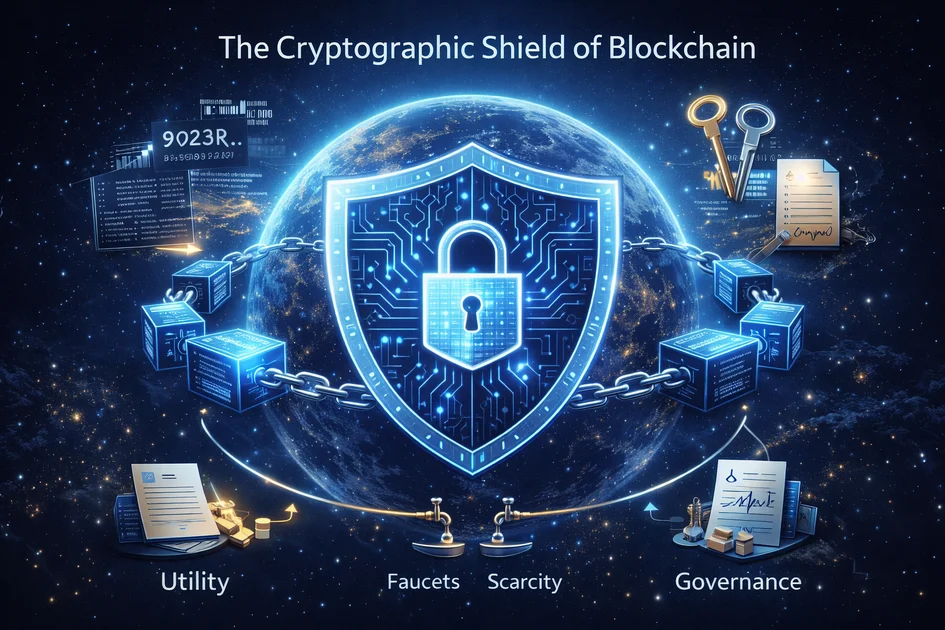
To understand blockchain security, you only need to understand three essential building blocks:
Hashing
Public-Key Cryptography
Digital Signatures
Let’s explore them step by step.
1. Hashing: The Blockchain Fingerprint
Imagine giving every piece of data a unique fingerprint.
That is exactly what a hash function does.
A hash takes any input, a word, a document, or an entire database and converts it into a fixed-length string of characters.
Example idea:
Input: Hello World
Output:
A94A8FE5CCB19BA61C4C0873D391E987...
Two properties make hashing powerful:
One-Way Function
You can easily create a hash from data.
But you cannot reverse the process to discover the original information.
This protects sensitive data from exposure.
Tiny Change → Completely Different Result
Change one letter and the hash changes entirely.
This is how blockchains detect tampering.
Every block contains:
Transactions
Its own hash
The hash of the previous block
If someone modifies past data, the hashes no longer match.
The chain immediately signals that something is wrong.
This property is what gives blockchain its famous immutability.
Hashing and Privacy
Modern privacy-focused systems like Midnight use hashing creatively.
Instead of storing sensitive documents directly on-chain, the network stores only the hash, the proof that the data existed, while the actual information remains private.
You get verification without exposure.
2. Public-Key Cryptography: Identity Without Permission
Traditional systems identify you using usernames and passwords controlled by companies.
Blockchain flips this model.
Identity comes from mathematics.
Public-key cryptography uses two keys:
Public Key → shared openly
Private Key → kept secret
Think of it like this:
Public key = your email address
Private key = your password
Your blockchain address is derived from your public key.
Your private key is what gives you control.
No bank.
No administrator.
No password reset.
Ownership equals cryptographic control.
Why This Matters
When using networks such as Bitcoin or Cardano:
Funds are not stored in a wallet.
They exist on the blockchain.
Your private key proves you are allowed to move them.
Lose the private key, access is permanently lost.
Security becomes personal responsibility.
Encryption and Confidentiality
Public-key cryptography also enables encrypted communication.
Data encrypted with a recipient’s public key can only be opened using their private key.
This allows blockchain systems to remain transparent while still protecting sensitive information, a principle central to privacy-preserving networks.
3. Digital Signatures: Trust Without Trust
Now comes the magic moment.
How does the network know a transaction truly came from you?
Through digital signatures.
When sending a transaction:
You create a message authorizing payment.
Your private key generates a digital signature.
The network verifies the signature using your public key.
If the signature matches, the transaction is accepted.
This provides three powerful guarantees:
> Authentication
The network confirms who initiated the transaction.
> Integrity
If anyone modifies the data after signing, the signature becomes invalid.
> Non-Repudiation
You cannot deny sending a transaction once signed.
Digital signatures replace institutional trust with mathematical verification.
How These Pieces Work Together
Individually, hashing, keys, and signatures are useful tools.
Together, they create something revolutionary:
Hashing protects data integrity.
Public-key cryptography establishes ownership.
Digital signatures authorize actions securely.
The result?
A system where strangers can safely exchange value without intermediaries.
No central authority required.
Why Cryptography Is the True Innovation
Blockchain is often described as a distributed database.
But its real breakthrough lies deeper.
Cryptography enables:
Security without guardians
Identity without institutions
Verification without exposure
Privacy alongside transparency
It transforms trust from a social agreement into a mathematical guarantee.
Once you understand cryptography, blockchain stops feeling mysterious.
You begin to see it for what it truly is: a global system secured not by people, but by proofs.
Replies
Discussion
Join the discussion
Sign in with Google to reply. You stay on this article while you sign in.
No replies yet
Sign in with Google to start the discussion.