The Thesis
Blockchain discussions often focus on consensus, tokenomics, or smart contracts. Yet none of these systems function without a foundational layer rarely understood outside infrastructure teams: networking.
A blockchain is not simply software, it is a global peer-to-peer (P2P) coordination system. Thousands of independent computers must continuously discover one another, exchange data, validate transactions, and remain synchronized without central servers.
This article examines the network architecture that transforms isolated machines into a resilient Layer-1 (L1) network capable of maintaining consensus, finality, and censorship resistance.
Why Blockchain Networking Exists
Traditional internet services rely on centralized infrastructure:
A banking app connects to bank servers.
Social media platforms depend on data centers.
Cloud providers control availability and up-time.
Blockchains attempt a fundamentally different objective:
Create a financial and computational system that continues operating even if individual operators fail, disconnect, or act maliciously.
The networking layer solves three core problems:
Discovery: How nodes find each other without a central registry.
Synchronization: How global state remains consistent.
Resilience: How the system survives attacks or outages.
Technology Deep Dive: The Blockchain Networking Stack
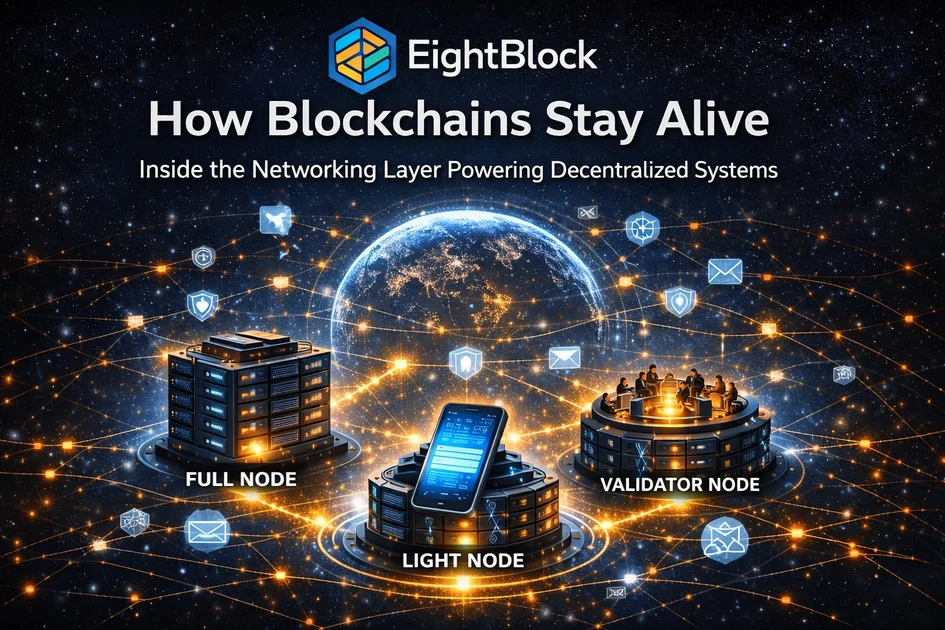
1. Node Architecture: Roles Inside a Blockchain Network
Not every participant contributes equally. Blockchain networks intentionally separate responsibilities across different node types.
Full Nodes: The Verification Backbone
Full nodes independently validate:
every block,
every transaction,
every consensus rule since genesis.
Characteristics:
Hundreds of gigabytes of storage
Persistent up-time
Independent verification
Non-custodial security guarantees
Running a full node means trust minimization. Exchanges, infrastructure providers, and sovereignty-focused users typically operate them.
They ensure that consensus rules cannot be silently altered.
Light Nodes (SPV Clients) - Accessibility Layer
Light nodes use Simplified Payment Verification (SPV).
Instead of downloading the entire chain, they:
store block headers only,
request Merkle proofs for relevant transactions.
This enables:
mobile wallets,
browser extensions,
low-resource devices.
The trade-off:
Benefit | Trade-off |
|---|---|
Low storage | Partial trust assumption |
Fast synchronization | Relies on honest majority |
Light clients make global participation possible without turning every user into a data center.
Archive Nodes — Historical Infrastructure
Archive nodes preserve:
historical states,
past balances,
full contract storage history.
They power:
block explorers,
analytics platforms,
compliance auditing tools.
Resource requirements often exceed multiple terabytes, making them specialized infrastructure components rather than typical user deployments.
Validator / Mining Nodes — Consensus Participants
These nodes extend full nodes with block production responsibilities.
Depending on the consensus model:
Proof-of-Work (PoW)
Compete through computational hashing.
Proof-of-Stake (PoS)
Lock tokens as collateral.
Propose and attest to blocks.
Modern PoS systems, including those built with the Cosmos SDK and CometBFT, separate networking from consensus logic, improving modularity and throughput.
2. Peer-to-Peer Topology: No Servers, No Authority
Unlike web applications, blockchains operate without centralized directories.
The Bootstrap Problem
A new node must discover peers before participating.
Common solutions include:
Hardcoded Seed Nodes
DNS Seed Discovery
Peer Exchange Protocols
Once connected, nodes maintain 8–125 peers, forming a distributed mesh network.
This redundancy eliminates single points of failure.
3. Message Propagation: Global Synchronization
When a transaction is broadcast:
Node validates locally.
Announces inventory (
invmessage).Peers request missing data.
Propagation continues recursively.
Within seconds, transactions reach most validators worldwide.
The mechanism resembles controlled rumor spreading, optimized for bandwidth efficiency and verification integrity.
This propagation phase directly affects:
mempool dynamics,
transaction latency,
MEV exposure,
finality times.
4. APIs and RPC Interfaces — The Application Layer
End-users rarely connect directly to P2P networks.
Applications communicate via:
JSON-RPC Interfaces
Used to:
query balances,
broadcast transactions,
monitor events.
Many developers rely on hosted providers instead of self-running nodes.
Examples include infrastructure platforms such as Infura and Alchemy.
While convenient, this introduces partial infrastructure centralization, an ongoing industry trade-off between usability and sovereignty.
5. Interoperability and Cross-Chain Networking
Modern blockchain ecosystems increasingly prioritize interoperability.
Frameworks like the Cosmos ecosystem employ:
Inter-Blockchain Communication (IBC) protocols
Independent sovereign chains
Shared networking standards
IBC allows chains to exchange data and assets without custodial bridges, improving security assumptions compared to wrapped-asset models.
Networking therefore expands beyond one chain, becoming an internet of blockchains.
Economic Model: Networking as an Incentive System
Blockchain networking survives because participants are economically motivated.
Staking Incentives
Validators earn:
block rewards,
gas fees,
delegation commissions.
Economic stake discourages malicious behavior.
Attacks become financially irrational rather than technically impossible.
Fee Structures (Gas Economics)
Gas fees serve multiple functions:
Prevent spam transactions.
Prioritize limited block space.
Fund validator operations.
Fees therefore act as both resource pricing and network security funding.
Infrastructure Decentralization Economics
Different actors specialize:
Participant | Incentive |
|---|---|
Validators | Revenue from staking |
Full nodes | Sovereignty & verification |
RPC providers | Infrastructure business model |
Users | Non-custodial access |
The network persists because incentives align operational costs with protocol sustainability.
The Real-World Problem: Digital Sovereignty
The networking layer ultimately addresses a political and economic issue:
Who controls access to financial and computational systems?
Centralized networks can be:
shut down,
censored,
sanctioned,
monopolized.
Blockchain networking removes dependency on centralized gateways.
This matters especially in regions facing:
unstable banking infrastructure,
limited financial inclusion,
restricted payment access.
A decentralized P2P network ensures participation requires only connectivity, not permission.
Ecosystem Analysis
Across modern L1 ecosystems:
Node participation continues to diversify geographically.
Hosted RPC services dominate on-boarding.
Light clients and mobile integrations drive adoption.
Modular frameworks accelerate new chain launches.
Testnets increasingly emphasize:
validator decentralization metrics,
peer diversity,
latency optimization,
cross-chain interoperability.
Community growth correlates strongly with ease of running nodes, not only token price performance.
The Blockchain Trilemma Assessment
How does networking influence the classic trilemma?
Dimension | Networking Impact |
|---|---|
Security | Independent verification by many nodes |
Decentralization | Open participation through P2P discovery |
Speed | Reduced due to global propagation requirements |
Blockchains deliberately sacrifice raw throughput to maintain resilience.
If maximum speed were the goal, centralized databases would already solve the problem.
Conclusion: The Invisible Infrastructure
Consensus algorithms secure blocks.
Tokenomics align incentives.
Smart contracts enable applications.
But none of it works without networking.
The blockchain P2P layer is an always-running coordination protocol, a system designed to survive outages, adversaries, and institutional failure.
Its defining characteristic is not efficiency.
It is persistence.
As modular architectures, interoperability standards, and light-client technologies mature, future adoption will depend less on speculation and more on infrastructure reliability.
The long-term challenge is clear:
Reduce operational complexity.
Maintain decentralization.
Avoid infrastructure concentration around large RPC providers.
Blockchains succeed not when they are fastest, but when they remain operational under conditions where traditional systems fail.
And that durability begins with the network itself.
Replies
Discussion
Join the discussion
Sign in with Google to reply. You stay on this article while you sign in.
No replies yet
Sign in with Google to start the discussion.