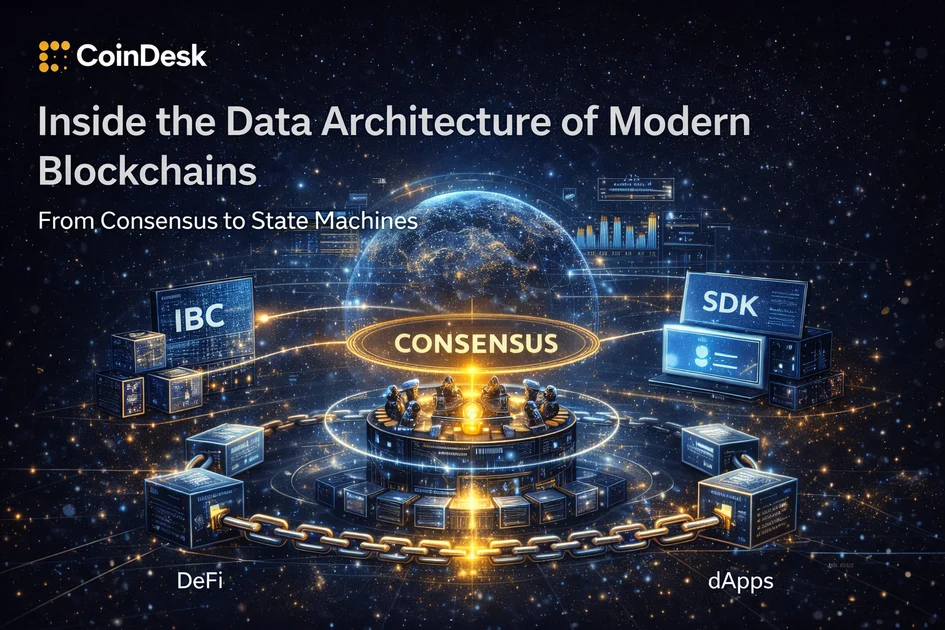
Executive Summary: The Thesis
Blockchain discussions often center on tokens, decentralization, or governance. Yet the durability of any Layer-1 (L1) network ultimately depends on a less visible layer: how data is structured, verified, and synchronized across a distributed system.
Modern blockchains combine consensus protocols, deterministic state machines, and cryptographic data structures to achieve three outcomes simultaneously:
Global agreement without custodians
Verifiable computation
Economic coordination among untrusted participants
This report examines how contemporary blockchain architectures, particularly those inspired by Cosmos-style modular design organize data, secure transactions, and scale interoperability while maintaining economic sustainability.
Technology Deep Dive
1. Consensus Layer: Finality Without Central Coordination
At the base of every blockchain lies a consensus mechanism responsible for ordering transactions and guaranteeing finality.
Proof-of-Stake as the Dominant Paradigm
Most modern L1 networks have transitioned toward Proof-of-Stake (PoS) due to its efficiency advantages over Proof-of-Work.
In PoS systems:
Validators stake native tokens as economic collateral.
A validator set proposes and votes on blocks.
Malicious behavior results in slashing, aligning economic incentives with protocol security.
Unlike probabilistic settlement in early networks, newer consensus engines aim for deterministic finality, once confirmed, a transaction cannot be reversed without catastrophic validator failure.
CometBFT and Byzantine Fault Tolerance
Many modular chains adopt CometBFT, a Byzantine Fault Tolerant (BFT) consensus engine derived from Tendermint.
Core properties include:
Instant finality after validator agreement
Safety maintained even if up to one-third of validators act maliciously
Predictable block times and throughput
Consensus operates in structured rounds:
Proposal
Pre-vote
Pre-commit
Finalization
This design prioritizes reliability and deterministic settlement, making it particularly suited for financial applications where rollback risk must be minimized.
2. Execution Layer: The Cosmos SDK State Machine
Consensus alone does not define blockchain behavior. Execution logic lives within the application layer, commonly implemented using the Cosmos SDK.
The SDK introduces an important architectural principle:
Blockchains as sovereign state machines.
Each chain defines its own:
Token economics
Governance rules
Fee markets
Permission models
Instead of one monolithic network attempting to serve all use cases, Cosmos-style systems allow specialized chains optimized for distinct workloads.
Key architectural components:
Modules: staking, governance, accounts, IBC, treasury
ABCI Interface: connects consensus engine to application logic
Deterministic State Updates: identical execution across all nodes
This modularity improves upgrade flexibility while maintaining consensus safety.
3. Data Structures: How Blockchains Store Truth
Efficient verification depends on structured data representation.
Merkle Trees - Efficient Verification
Blocks aggregate transactions using Merkle Trees.
Benefits:
Verifies inclusion using logarithmic data size
Enables light clients and mobile wallets
Reduces bandwidth requirements dramatically
A single Merkle root cryptographically represents thousands of transactions, allowing verification without full chain downloads.
State Trees
While blocks store history, state trees store the present.
They maintain:
Account balances
Smart contract storage
Validator states
Most implementations use variants of Merkle Patricia Trees, enabling nodes to query current balances without replaying the entire chain.
The Mempool: Transaction Market Dynamics
Before inclusion in a block, transactions reside in the mempool.
Validators prioritize transactions based on:
Gas fees
Size efficiency
Network demand
This mechanism creates a real-time auction for block space, directly linking economic demand to throughput utilization.
4. Interoperability Layer: IBC and Cross-Chain Sovereignty
One of the defining innovations of modern blockchain infrastructure is interoperability.
The Inter-Blockchain Communication (IBC) protocol enables:
Trust-minimized cross-chain transfers
Independent sovereign chains
Shared liquidity across ecosystems
IBC avoids custodial bridges by verifying counterparty consensus proofs instead of trusting intermediaries.
Result:
A network of interoperable blockchains rather than a single dominant chain.
Economic Model Analysis
Tokenomics and Network Security
The native token performs three core functions:
1. Staking Security
Validators stake tokens to participate in consensus.
Security derives from:
Economic penalties for malicious behavior
Reward distribution proportional to stake participation
Higher staking participation generally increases network resilience.
2. Fee Structure and Gas Markets
Users pay gas fees to execute transactions and smart contracts.
Functions of fees:
Prevent spam attacks
Allocate scarce block space efficiently
Compensate validators
Some networks introduce dynamic fee markets or fee burning mechanisms to stabilize long-term token supply.
3. Incentive Alignment
Token emissions typically balance:
Validator rewards
Ecosystem funding
Long-term scarcity
Poorly calibrated emissions risk either:
Inflationary dilution, or
Reduced validator participation.
The “Why”: Real-World Problem Alignment
Beyond technical sophistication, blockchain adoption depends on solving concrete problems.
Modern PoS + IBC architectures primarily address three structural limitations:
Financial Sovereignty
Non-custodial systems allow users to control assets without reliance on centralized intermediaries.
Interoperable Infrastructure
IBC enables region-specific chains (for payments, identity, or supply chains) to communicate without sacrificing independence.
Privacy-Preserving Computation
Emerging integrations with zero-knowledge systems like Midnight aim to allow verification without data exposure, increasingly relevant for enterprise and regulatory environments.
These features are particularly relevant in regions where banking infrastructure, identity systems, or cross-border settlement remain inefficient.
Ecosystem Analysis
Typical ecosystem maturity progresses through:
Testnet Phase: validator onboarding and stress testing
Mainnet Launch: token distribution and governance activation
dApp Expansion: DeFi, identity, payments, and data infrastructure
Interoperability Integration: IBC channel expansion
Successful ecosystems demonstrate:
Growing validator decentralization
Increasing non-custodial wallets
Sustained developer activity rather than speculative spikes
The Blockchain Trilemma Assessment
Dimension | Evaluation |
|---|---|
Security | Strong via BFT consensus and economic staking penalties |
Decentralization | Dependent on validator distribution and stake concentration |
Scalability | Achieved horizontally through sovereign interconnected chains |
Rather than maximizing all dimensions within a single chain, modular ecosystems externalize scalability through interoperability.
This represents a structural evolution from monolithic blockchain design.
Conclusion: Outlook and Adoption Challenges
Modern blockchain architecture demonstrates a clear industry direction:
Modular execution environments
Deterministic finality
Cross-chain interoperability
Economically aligned security models
However, adoption hurdles remain:
Validator centralization risks
Complex user experience across chains
Governance participation fatigue
Regulatory uncertainty around non-custodial systems
The next phase of blockchain development will likely be determined less by raw throughput and more by institutional reliability, usability, and interoperable standards.
In short, the competitive advantage of future L1 networks will not be speed alone, but credible neutrality combined with programmable sovereignty.
Replies
Discussion
Join the discussion
Sign in with Google to reply. You stay on this article while you sign in.
No replies yet
Sign in with Google to start the discussion.