Introduction
During my time at European Business Institute Luxembourg (EBU) and Coxygen Global, I was introduced to Marlowe as a practical and approachable way to create smart contracts on Cardano. What stood out to me was not only its technical soundness, but also its ability to lower the entry barrier for people who are not deeply technical.
I found this especially worth sharing with the Cardano ecosystem, so that both newcomers and existing community members can discover Marlowe, understand its potential, and explore whether it can be a useful tool for their own projects.
1. What is Marlowe (Simply and Technically)
Marlowe is a Domain-Specific Language (DSL) designed specifically for financial smart contracts on Cardano. Unlike general-purpose smart contract languages, Marlowe follows a declarative and structured approach, based on a limited set of logical constructions.
This design choice solves three major challenges in DeFi:
overly complex code
vulnerability to coding errors
difficulty in auditing and understanding contracts
Marlowe is not meant for all applications but focuses on correctly modeling financial agreements such as payments, deposits, conditions, and timeouts.
2. Core Concepts of Marlowe
Marlowe is built on a small number of fundamental blocks that cover most financial contracts:
Parties: the participants (addresses or roles)
Deposit: funds deposited into the contract
Pay: payments executed from the contract
Choice: decisions made by a party
Conditions (If / Observation): logical rules
Timeout: strict time management
These components form a finite-state machine, ensuring contracts progress in a controlled manner and always reach a conclusion.
3. Why Marlowe is Suitable for Beginners and Serious Projects
Marlowe combines three key features:
Simplicity: few, clearly defined concepts
Security: no infinite loops, no unexpected behaviors
Readability: contract logic is understandable even without advanced coding skills
This makes it possible for non-technical users to participate in smart contract creation while remaining usable in professional contexts.
4. Step-by-Step Guide: Using Marlowe in Practice
Step 1: Access Marlowe Playground
Marlowe Playground is the official environment for creating and testing Marlowe contracts.
You can use:
a visual interface (blocks)
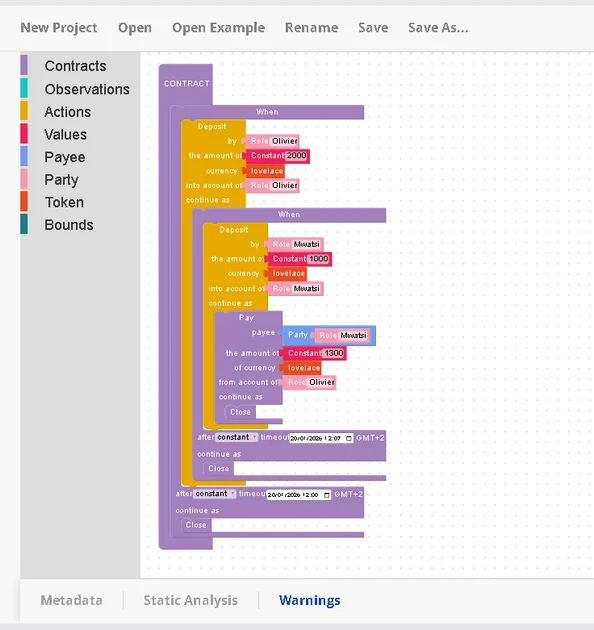
simplified Marlowe textual syntax
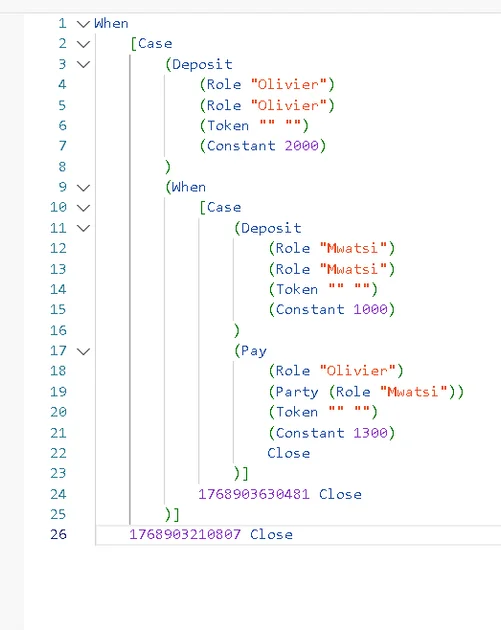
For beginners, the visual interface is highly recommended, as it allows you to build smart contracts by assembling logical blocks without writing code.
You can access this environment through the Marlowe Playground, which provides everything needed to design, simulate, and analyze contracts.
To get started quickly, you may also follow this step-by-step video tutorial that demonstrates how to build smart contracts using blocks in Marlowe Playground
Step 2: Define Contract Parties
Start by identifying:
who participates in the contract
the role of each party
These parties will be used in deposits, payments, and choices.
Step 3: Build the Financial Logic
Using Marlowe blocks, define:
expected deposits
conditions to be met
payments to be executed
Each action connects to the next, forming a clear, deterministic flow.
Step 4: Add Timeouts
Associate each important interaction with a timeout to ensure:
the contract never gets stuck
alternative paths exist in case of inaction
Time management is a key security feature in Marlowe.
Step 5: Simulate the Contract
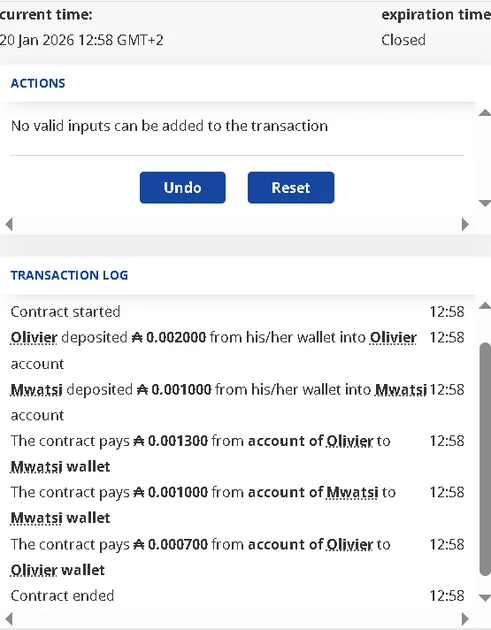
Before deployment, simulation allows you to:
test all possible scenarios
verify each branch of the contract
ensure no funds can get stuck
Simulation is essential and integral to the Marlowe workflow.
Step 6: Deploy on Cardano
Once validated, deploy the contract on the Cardano blockchain. At this stage, the contract becomes:
autonomous
immutable
executed strictly according to defined rules
5. Essential Use Cases
Marlowe is particularly suited for:
escrow contracts
simple loans
conditional payments
programmed savings
multi-party agreements
These cover a large portion of real-world financial needs.
6. Marlowe and Plutus: Key Takeaways
Marlowe and Plutus are complementary:
Marlowe simplifies and secures standard financial contracts
Plutus enables more complex and general logic
For many projects, Marlowe provides a sufficient first layer.
Conclusion
Marlowe offers a minimalistic yet powerful approach to smart contracts on Cardano. By focusing on essential concepts, it enables the creation of financial contracts that are understandable, testable, and secure, without exposing users to unnecessary technical complexity.
Beyond simplifying contract creation, Marlowe demonstrates the strength and potential of Cardano as a blockchain platform:
its model supports secure, predictable, and auditable contracts
it enables a wider audience to participate in DeFi
it reinforces Cardano’s vision of accessible, decentralized financial infrastructure
For anyone looking to move from theory to practice on Cardano, Marlowe is an excellent starting point that showcases Cardano’s capacity to empower developers and non-developers alike.
Note
This article is provided for informational and educational purposes only. To learn more about Marlowe, explore advanced concepts, and access up-to-date resources, readers are encouraged to refer to the official Marlowe documentation
Replies1
Discussion
Join the discussion
Sign in with Google to reply. You stay on this article while you sign in.