
Most blockchain developers are used to one simple model:
Hold a token → spend the token as gas.
Ethereum uses ETH. Solana uses SOL. Most chains follow the same pattern.
Midnight does not.
At first glance, the NIGHT ↔ DUST model can feel confusing:
Is DUST a token?
Do users buy it?
Why not just use NIGHT directly?
How do transaction fees actually work?
What changes for developers building applications?
But once you understand the architecture, you realize Midnight is solving one of the biggest problems in blockchain development:
unpredictable operational costs.
This article explains NIGHT and DUST from a developer perspective, not just what they are, but why they matter, how they work, and how they unlock new application design patterns on Midnight.
The Core Problem Most Blockchains Still Haven’t Solved
Traditional blockchain gas models create friction for both developers and users.
Imagine building a real application:
a payment platform
a ticketing system
a game
an identity product
a healthcare application
an enterprise tool
You need predictable operating costs.
But on most chains:
gas fees fluctuate constantly
token prices are volatile
users must actively manage gas balances
onboarding becomes difficult
business forecasting becomes painful
A simple transaction that costs $0.20 today could cost $15 tomorrow.
For developers, this creates serious issues:
difficult pricing models
poor UX
unstable infrastructure costs
user frustration
complicated onboarding flows
Midnight approaches this differently.
Understanding the Midnight Model
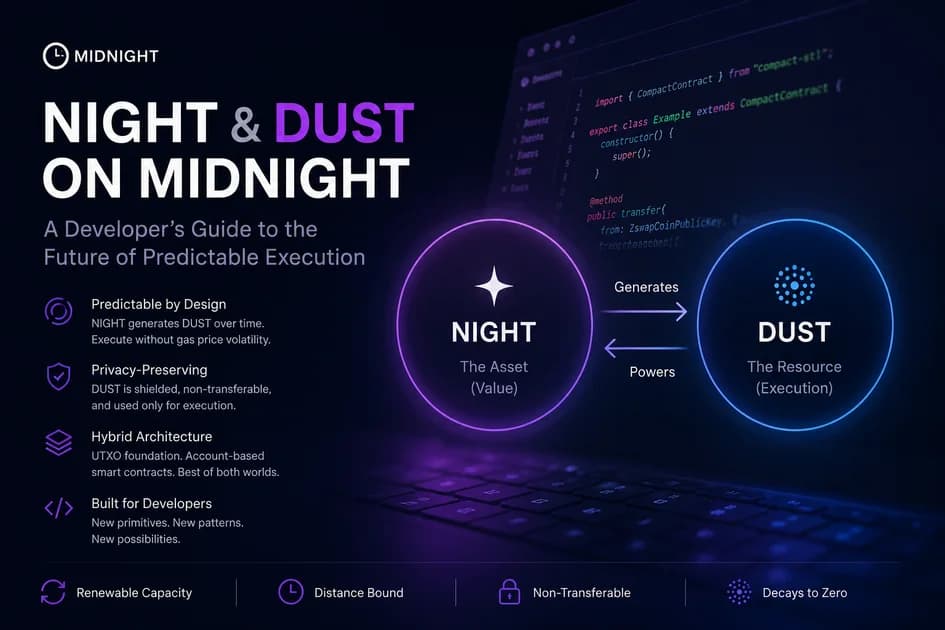
Midnight separates:
the capital asset
from the network resource
This is the key idea.
NIGHT = the asset
NIGHT is Midnight’s native utility token.
It:
exists as UTXOs on the ledger
can be transferred
can be traded
can be held as value
supports governance and ecosystem participation
Think of NIGHT as ownership or stored value.
DUST = the network resource
DUST is not a token.
DUST is:
non-transferable
shielded
consumable
renewable
used only for transaction execution
DUST behaves more like computational bandwidth than money.
You don’t trade DUST.
You don’t speculate on DUST.
You simply use it to operate on the network.
The Best Analogy: Solar Panels
The Midnight docs use one of the best analogies possible.
NIGHT is the solar panel
DUST is the electricity
If you own solar panels:
they continuously generate electricity
electricity powers your devices
you consume the electricity
the panels remain yours
Midnight works similarly.
Holding NIGHT continuously generates DUST over time.
You spend DUST to execute transactions.
As long as you still hold NIGHT:
more DUST continues regenerating.
Why This Changes Everything for Developers
This model sounds simple, but the implications are huge.
1. Predictable Operational Costs
This is probably the biggest innovation.
On traditional chains:
gas costs depend heavily on token market prices
On Midnight:
transaction execution depends on generated DUST capacity
This creates significantly more predictability.
A business can estimate:
infrastructure usage
transaction throughput
operational capacity
without constantly worrying about token volatility.
2. Better User Experience
Most users do not want to think about gas.
They want applications to simply work.
Midnight allows developers to build experiences closer to traditional applications:
no constant gas anxiety
simpler onboarding
less wallet friction
more abstracted infrastructure
This is especially important for:
mainstream users
enterprises
mobile-first products
African markets
non-crypto-native audiences
3. Developers Can Design New Economic Models
Because NIGHT generates DUST, applications can rethink how infrastructure access works.
Examples:
subscription-style applications
sponsored transactions
enterprise infrastructure pools
organization-managed DUST generation
shared operational wallets
delegated execution systems
This opens entirely new product architectures.
DUST Is NOT “Gas Tokens”
A common misunderstanding:
developers often compare DUST to “gas tokens.”
That’s inaccurate.
DUST is fundamentally different because:
it is non-transferable
it decays
it regenerates
it is tied to NIGHT ownership
it is shielded
This means DUST behaves more like renewable network capacity than currency.
How DUST Actually Works
The lifecycle matters.
When NIGHT is held:
DUST generates over time.
When DUST is spent:
it is consumed during transaction execution.
When NIGHT is moved or spent:
the associated DUST begins decaying.
This is critical.
You cannot permanently accumulate infinite DUST disconnected from NIGHT ownership.
The relationship between NIGHT and DUST remains linked.
The Generation Model
Current Midnight parameters:
1 NIGHT can generate up to 5 DUST
full capacity is reached over roughly one week
DUST regenerates linearly over time
So:
holding more NIGHT increases your DUST capacity
spending DUST does not destroy your NIGHT
moving NIGHT affects DUST generation and decay
This creates a renewable execution model.
Why Developers Should Care About Decay
At first, decay might sound inconvenient.
But it solves several important problems:
prevents resource hoarding
prevents detached speculative markets
preserves network fairness
reduces spam vectors
keeps the system tied to actual participation
Without decay, DUST itself could become another speculative asset.
Midnight intentionally avoids this.
Privacy Matters More Than Developers Think
One underrated aspect:
DUST itself is shielded.
That means:
usage patterns gain privacy protections
execution activity becomes harder to profile
infrastructure behavior becomes less transparent to attackers
This is extremely valuable for:
enterprise systems
healthcare
private finance
gaming
identity systems
confidential applications
Most chains expose operational behavior publicly.
Midnight reduces that exposure.
The Hybrid Architecture Advantage
Another thing developers often miss:
Midnight is not “just a UTXO chain.”
It combines:
UTXO-based infrastructure
with account-based smart contract capabilities
This hybrid architecture matters.
UTXO layer advantages:
parallelism
efficiency
privacy
scalability
Account-based contract advantages:
familiar smart contract patterns
complex state management
programmable application logic
This means developers can:
use ledger tokens for efficiency
use contract tokens for programmability
combine both inside the same application
That flexibility is powerful.
Real Examples Developers Can Build
Ticketing Platforms
A ticket system could:
issue private attendance proofs
verify age without revealing birthdays
process tickets privately
maintain transparent event validation
Users prove eligibility without exposing personal information.
Enterprise Payment Systems
Businesses could:
maintain predictable transaction infrastructure
avoid volatile fee exposure
execute confidential operations
manage operational budgets more cleanly
Private Gaming Systems
Games can:
hide player inventory
shield strategic actions
verify fairness with ZK proofs
maintain transparent reward logic
Identity & Credentials
Applications can:
verify credentials privately
prove eligibility
avoid exposing sensitive user data
maintain compliance without revealing raw information
This is where Midnight becomes extremely interesting.
The Most Important Developer Shift
The biggest mindset shift is this:
On Midnight, gas becomes infrastructure capacity, not speculative spending.
That changes:
onboarding
UX
scalability planning
application economics
enterprise adoption
privacy architecture
The NIGHT → DUST model is not just tokenomics.
It is infrastructure design.
Questions Developers Usually Ask
“Do users need to constantly buy DUST?”
No.
Users hold NIGHT, which generates DUST automatically.
“Can DUST be traded?”
No.
DUST is non-transferable by design.
“Can I build applications without exposing user activity?”
Yes.
That is one of Midnight’s core strengths.
“Can applications abstract fees away from users?”
Potentially yes.
The architecture enables much more flexible execution models.
“Does this remove volatility completely?”
No.
But it significantly improves operational predictability compared to traditional gas systems.
Why NIGHT & DUST Matter Long-Term
Most blockchain infrastructure today still treats:
speculation
network usage
operational costs
as the same thing.
Midnight separates them.
That separation may end up being one of the most important infrastructure decisions in modern blockchain architecture.
Because for real adoption:
developers need more than decentralization.
They need:
predictable systems
better UX
privacy
scalable economics
business-friendly infrastructure
And Midnight is clearly designing toward that future.
Final Thoughts
The NIGHT and DUST architecture can initially feel unfamiliar because it breaks away from traditional blockchain assumptions.
But from a developer perspective, it solves real problems:
volatile gas pricing
poor onboarding
operational unpredictability
privacy limitations
rigid application economics
Midnight is not simply introducing a new token model.
It is introducing a new way to think about blockchain infrastructure itself:
renewable execution resources
privacy-preserving computation
hybrid architecture
programmable confidentiality
predictable operational design
For developers building the next generation of applications, that shift matters.
Discussion
Join the conversation
Connect your wallet to share your thoughts and engage with the community
No comments yet
Connect your wallet to be the first to comment!