Two ways to agree on a block
Every blockchain has to solve the same basic problem: thousands of independent computers need to agree on what the next block is, without a central authority deciding for them. The two dominant approaches to this problem are proof of work and proof of stake.
Proof of work, used by Bitcoin, has participants compete to solve a computationally difficult puzzle. Whoever solves it first gets to add the next block, and is rewarded for doing so. It works, but it's expensive by design: the security comes from how much real-world energy it costs to cheat.
Proof of stake takes a different path. Instead of competing on computing power, it selects who gets to produce each block based on how much of the network's native asset they hold and have put at stake. Cardano uses this model, and does so through a protocol called Ouroboros.
What Ouroboros is
Ouroboros is Cardano's consensus protocol, and it holds a specific distinction: it was the first proof-of-stake protocol to be built on peer-reviewed academic research and formally proven secure, rather than designed and only tested afterward. Cardano's official documentation describes it as secure as long as more than half of the stake in the system, meaning ADA, is held by honest participants [1].
Ouroboros isn't a single, static design. It's a family of related protocols that has evolved over Cardano's history, each version adding capability on top of the last:
Ouroboros Classic established the original mathematical framework and incentive structure for proof of stake.
Ouroboros BFT was a simplified, federated version used during Cardano's early Byron era, run by a known, trusted set of nodes while the network was still bootstrapping.
Ouroboros Praos introduced the version used through most of Cardano's life, adding resistance to a wider range of adversarial conditions and formalizing how blocks are organized into slots and epochs.
Ouroboros Genesis extended Praos to let new or returning nodes securely sync with the correct chain from nothing, without needing to trust a third party for a starting point.
Ouroboros Hydra is a layer-two scaling design intended to let Cardano process far more throughput, separate from the base-layer consensus mechanism itself [2].
Time, broken into slots and epochs
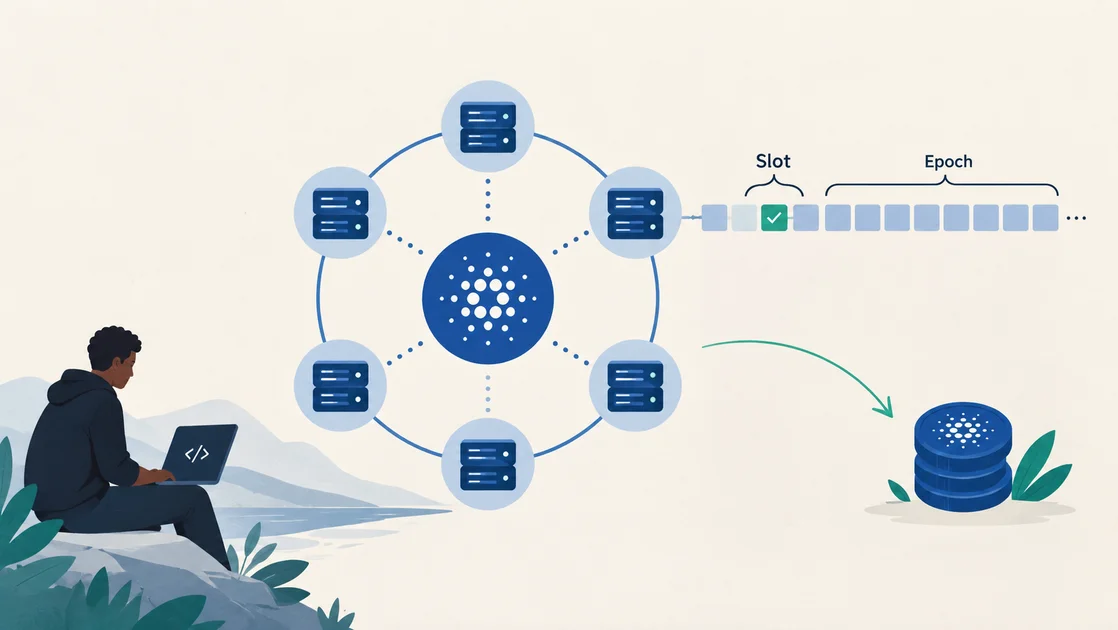
Ouroboros doesn't let every node try to produce a block whenever it wants. Time on Cardano is divided into fixed units, and this structure is what makes fair, predictable leader selection possible.
The smallest unit is a slot, which lasts one second. Slots are grouped into epochs, and each epoch currently contains 432,000 slots, which works out to five days [3]. At most one block can be produced in any given slot, and only the stake pool chosen as that slot's leader is entitled to produce it.
Because leader selection is tied to the stake distribution at the start of an epoch, and that distribution can shift as people delegate or move ADA, Ouroboros re-evaluates who's eligible to lead at each new epoch boundary. This is also why rewards aren't paid out block by block: instead, everything earned across an epoch is pooled together and distributed afterward, proportional to participation [4].
How a slot leader is actually chosen
This is the part that replaces mining. Rather than racing to solve a puzzle, each stake pool is privately and verifiably checked, slot by slot, against a threshold tied to how much stake is delegated to it. A pool with more delegated stake has a proportionally higher chance of being selected as leader for any given slot, but the outcome itself is randomized, not predetermined, and only the winning pool can prove it won before the block appears.
Cardano's own materials describe this random selection as central to Ouroboros's security guarantees, specifically calling out "unbiased randomness in the protocol's leader selection algorithm" as what distinguished Ouroboros from earlier proof-of-stake designs [1][2]. In practice, this randomness is generated using cryptographic techniques from the underlying Ouroboros Praos research, allowing a stake pool to privately know in advance when it has won the right to produce a block, while still letting the rest of the network verify afterward that the selection was fair and not manipulated.
A slot leader that produces a block bundles up pending transactions, signs the block, and adds it to the chain. Because multiple competing chains can briefly exist if messages arrive out of order across the network, Ouroboros also defines a settlement delay: new blocks are treated as provisional for a short window, and only the chain preceding that window is considered final. This is the mechanism through which the ledger's history is securely agreed upon across the whole network [2].
Stake pools and delegation
Running a stake pool means running reliable, always-on infrastructure capable of participating in block production whenever selected. Not every ADA holder wants to do that, which is why Ouroboros includes stake delegation: any ADA holder can delegate their stake to a pool run by someone else, increasing that pool's chance of being chosen as a slot leader and earning a share of the resulting rewards, without running any infrastructure themselves [4][5].
A few concrete points worth knowing if you're considering delegating:
Delegating does not move or lock your ADA. Your funds stay in your own wallet, under your own control, the entire time. What you're doing is pointing a separate staking key toward a pool, not transferring custody of anything [6].
Delegation itself requires two on-chain certificates: a stake address registration, and a delegation certificate pointing that stake address at a chosen pool. Registering a stake address requires a refundable deposit, currently documented as 2 ADA, which you get back if you later deregister [5][7].
There is no slashing on Cardano. Some proof-of-stake networks penalize misbehaving or offline validators by destroying a portion of their stake. Cardano's official documentation is explicit that this isn't how Ouroboros works: a pool that performs badly simply earns fewer rewards, delegators included, but nobody's underlying ADA is forcibly destroyed as a penalty [5].
Why pool size is deliberately capped
Left alone, delegation would tend to concentrate stake into whichever pools already look most attractive, which is exactly the kind of centralization a proof-of-stake network needs to avoid. Ouroboros counters this with two protocol parameters that directly shape stake pool economics.
The first is the saturation parameter, k. It sets a cap on how much delegated stake counts toward a single pool's rewards. Once a pool's total stake passes that cap, additional delegation stops increasing its rewards, which makes oversized pools less attractive to new delegators and nudges stake toward smaller, less saturated pools instead. As one concrete, officially documented example: when Cardano's k parameter was raised from 150 to 500 at epoch 234, the resulting saturation point, the maximum stake that still earned full rewards per pool, dropped from roughly 220 million ADA to just under 64 million ADA [8]. Because k is a governable protocol parameter, its exact value changes over time, so rather than quote a single number as permanently current, it's worth checking a live source such as a Cardano block explorer or the current protocol parameters for today's figure.
The second is the pledge influence parameter, a0. Pool operators can optionally pledge some of their own stake into their pool, and a0 determines how much that pledge boosts the pool's total rewards. A pool with meaningful owner pledge is rewarded with a small additional bonus on top of ordinary delegation rewards, which signals the operator has skin in the game and discourages a single entity from quietly running dozens of low-pledge pools to farm rewards [9][10].
Where staking rewards actually come from
Rewards on Cardano come from two distinct sources each epoch: transaction fees collected across the network, and newly issued ADA drawn from Cardano's reserve through a process called monetary expansion [4]. Both are pooled together into a single reward pot for that epoch, rather than being paid out per block, and that pot is then split: a portion is historically directed to Cardano's on-chain Treasury, which funds ongoing ecosystem development through community governance, with the remainder distributed across participating stake pools and their delegators, proportional to stake and adjusted by each pool's performance, pledge, and saturation [4][8][9]. Because the exact treasury split is itself a governable parameter under Cardano's Voltaire-era on-chain governance, it's worth checking current figures directly rather than assuming a historical number still applies today.
From federated nodes to full decentralization
Cardano's current, fully community-run block production wasn't the starting point. In its early Byron era, block production ran on a federated set of nodes operated by Input Output, Emurgo, and the Cardano Foundation, governed by a transitional protocol called Ouroboros BFT, while the stake pool operator ecosystem was still forming.
That handover was governed by a specific protocol parameter, d, representing the proportion of blocks still produced by those federated nodes rather than by independent stake pools. Over several months following the Shelley upgrade, d was reduced in small steps until, on March 31, 2021, at the boundary of epoch 257, it reached zero. From that point on, one hundred percent of Cardano's blocks have been produced by independent, community-run stake pools, with no built-in role for the original federated nodes at all [11][12].
Why this design matters
The headline reason proof of stake gets discussed alongside proof of work is energy use, and the gap is substantial. Cardano's own materials cite up to four million times the energy efficiency of Bitcoin for equivalent network security [2]. That's possible because Ouroboros doesn't ask participants to out-compute each other; it asks them to hold and responsibly delegate stake, with the protocol's own cryptography handling fair, verifiable selection.
But the energy argument is really a side effect of a deeper design choice: security that scales horizontally. A proof-of-work network gets more secure by adding more raw computing power. Ouroboros gets more secure by distributing stake and participation across more independent pools, which is also why mechanisms like saturation and pledge influence aren't incidental details. They're the protocol actively working to prevent the exact kind of concentration that would undermine the honest-majority assumption its entire security proof depends on.
Sources
Ouroboros, Cardano's Proof-of-Stake Protocol : Cardano Foundation, official overview, including the "51% of stake held by honest participants" security property and the energy efficiency comparison with Bitcoin
Ouroboros implementation history (Classic, BFT, Praos, Genesis, Hydra) : Cardano Foundation documentation
Consensus and staking : Cardano developer documentation, on slot length, epoch length, and stake pools
Reward pooling and distribution mechanics : Cardano developer documentation, consensus and staking section
Staking : Cardano developer documentation, confirming no slashing and that ADA never leaves the holder's wallet during delegation
Delegation custody behavior : Cardano developer documentation, staking and governance curriculum
Delegation : official Cardano documentation on stake address registration and delegation certificates, including the registration deposit
Changes on k parameter on epoch 234 : Input Output, official support article documenting the k parameter change and resulting saturation point
Run a Cardano Stake Pool : Cardano Foundation, on the saturation parameter k and pledge influence parameter a0
The general perspective on staking in Cardano : Input Output Global, official guidance for delegators and stake pool operators on k and a0
Decentralization: to D=0 Day and beyond : Input Output, official announcement of the d parameter reaching zero
Not long till 'd' (=0) day : Input Output, official background on the decentralization parameter and timeline
For current, live protocol parameters (including the present values of k, a0, and the treasury rate, all of which are adjustable through governance and change over time), check a Cardano block explorer or the official documentation directly rather than relying on any article for today's exact figures.
Replies
Discussion
Join the discussion
Sign in with Google to reply. You stay on this article while you sign in.
No replies yet
Sign in with Google to start the discussion.