The Thesis
Smart contracts turned blockchains from simple payment systems into programmable platforms. They allow agreements to execute automatically, without banks, intermediaries, or trusted third parties.
But traditional smart contracts come with a major limitation: everything is public.
Every transaction, every balance, and often every interaction is visible on-chain.
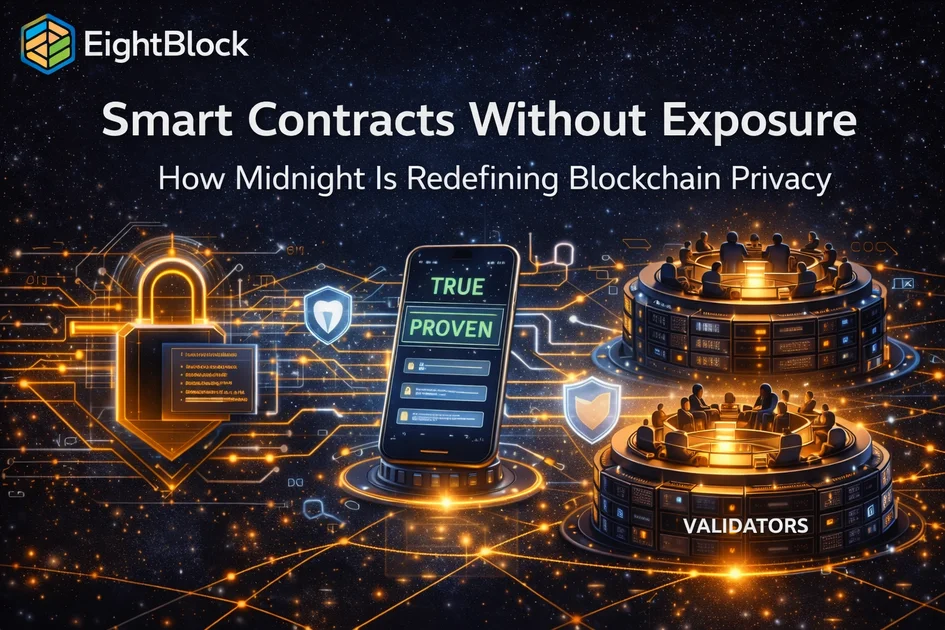
Midnight proposes a different model, one where smart contracts remain verifiable without exposing private data. Instead of sharing information, users prove that something is true using cryptography.
The goal is simple:
Automation + Verification + Privacy.
What Smart Contracts Really Are
A smart contract is not magic and not artificial intelligence.
It is simply code stored on a blockchain that executes automatically when conditions are met.
Once deployed:
The code cannot be changed.
Every validator runs the same program.
Every node reaches the same result.
Think of it as thousands of computers independently checking the same calculation and agreeing on the answer.
Consensus ensures everyone agrees on what happened.
Smart contracts define what should happen next.
The Building Blocks of a Smart Contract
Understanding smart contracts becomes easier when you see their main components.
1. State Variables: Permanent Memory
State variables store the contract’s long-term data.
Examples:
token balances
ownership information
voting results
escrow funds
This data lives permanently on the blockchain. Every node stores the same version, which removes the need for a central database.
2. Functions: The Actions
Functions are the operations users can trigger.
Typical functions include:
transfer tokens
deposit funds
vote in governance
withdraw assets
When someone calls a function, validators execute it and update the blockchain state.
3. Modifiers: Built-In Security
Modifiers act like security guards.
They check conditions before a function runs.
For example:
only the owner can perform admin actions
users must meet certain requirements
rules must be satisfied before execution
Instead of rewriting checks everywhere, developers reuse modifiers across functions.
4. Events: Communication With the Outside World
Events announce that something happened.
They do not change blockchain data. Instead, they notify wallets, dashboards, and applications.
Example:
Tokens transferred
Vote completed
Payment released
Your wallet interface updates because it listens for these events.
How Everything Works Together
A smart contract interaction follows a predictable flow:
State variables store current data
A user calls a function
Modifiers verify permissions
The function executes
Blockchain state updates
Events notify external applications
This deterministic process allows thousands of independent computers to agree without trusting each other.
Midnight’s Key Innovation: Private Smart Contracts
Most blockchains operate with radical transparency.
Anyone can see:
balances
transactions
contract interactions
This works for open finance but creates problems for real-world adoption.
Businesses, institutions, and individuals often need confidentiality.
Midnight introduces privacy-preserving smart contracts using zero-knowledge proofs.
How Zero-Knowledge Execution Works
Instead of uploading sensitive data to the blockchain:
You keep your private information locally.
You generate a cryptographic proof.
The network verifies the proof.
Validators confirm correctness without seeing your data.
The blockchain verifies truth, not information.
Example:
You can prove you qualify as an accredited investor without revealing your net worth.
It’s similar to showing a bouncer proof you’re over 18 without revealing your birthday or identity details.
Consensus and Execution
Smart contracts still rely on blockchain consensus to function securely.
In a Proof-of-Stake environment:
Validators stake tokens.
They execute transactions and smart contracts.
They verify cryptographic proofs.
Finality ensures confirmed transactions cannot be reversed.
Execution remains decentralized, but sensitive data never becomes public.
Economic Model
Gas Fees
Every smart contract interaction consumes computation.
Users pay fees (Gas) for:
executing code
updating blockchain state
verifying proofs
These fees compensate validators for maintaining the network.
Staking Incentives
Validators lock tokens as collateral to participate in block production.
If validators behave honestly, they earn rewards.
If they act maliciously, they risk losing their stake.
This economic design aligns incentives toward network security.
Token Utility
The native token typically powers the ecosystem through:
transaction fees
staking participation
governance voting
protocol coordination
Usage strengthens network security through economic participation.
The Real Problem Midnight Solves
Public smart contracts introduced automation but ignored privacy requirements.
Real-world systems require:
confidential financial operations
private identity verification
regulatory compliance
enterprise data protection
Traditional blockchains struggle here.
Midnight enables automation without exposure.
Potential applications include:
confidential DeFi
private digital identity
automated insurance payouts
compliant institutional finance
DAO treasury governance
The objective is not secrecy, it is controlled disclosure.
Ecosystem Outlook
Privacy-enabled smart contracts are attracting developers exploring:
identity systems
confidential payments
governance frameworks
enterprise blockchain integrations
As tooling improves, developers gain the ability to build applications that combine decentralization with practical privacy requirements.
The Blockchain Trilemma Assessment
Blockchains must balance three competing goals:
Dimension | Midnight Approach |
|---|---|
Security | Cryptographic proofs + staking incentives |
Decentralization | Validator-based execution |
Scalability | Reduced on-chain data through proofs |
By verifying proofs instead of storing raw data, Midnight reduces network load while preserving trust guarantees.
Conclusion
Smart contracts removed intermediaries.
The next evolution removes unnecessary transparency.
Midnight represents a shift toward:
programmable privacy
verifiable computation
user data sovereignty
Challenges remain:
developer learning curve
infrastructure maturity
proof verification costs
regulatory adaptation
But the direction of blockchain evolution is becoming clearer.
Blockchains are no longer just public ledgers.
They are evolving into privacy-aware execution environments capable of supporting real economic systems.
Smart contracts are no longer just automated programs.
They are becoming cryptographic agreements, enforceable, decentralized, and confidential by design.
Replies1
Discussion
Join the discussion
Sign in with Google to reply. You stay on this article while you sign in.