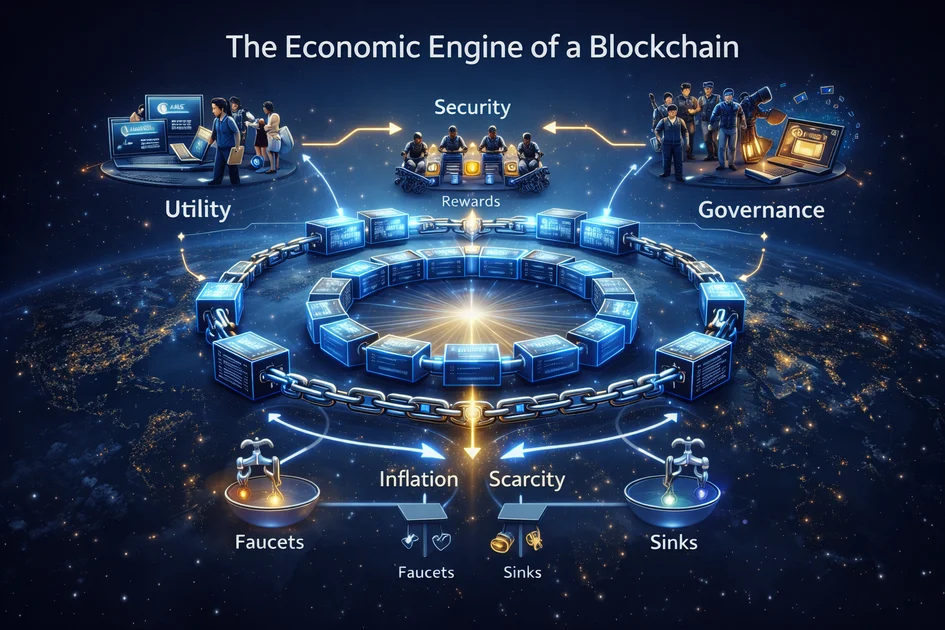
We often explain blockchain in technical terms.
Consensus algorithms.
Cryptographic hashes.
Distributed networks.
But here is what many people do not realise at first:
Technology is only half the story.
The other half is economic design.
More specifically, how you design a token system that motivates thousands of strangers to behave in ways that keep the network secure, efficient, and alive.
Once you understand this, blockchain stops being “interesting technology” and starts becoming something far more powerful: a self-sustaining economic system.
The Real Problem Blockchains Must Solve
A public blockchain faces three fundamental challenges:
How do you persuade thousands of independent operators to run computers 24/7?
How do you prevent spam and abuse?
How do you make decisions when no single entity is in charge?
The answer to all three questions is the same:
Tokens.
Not simply as digital money, but as an integrated system of incentives, penalties, and coordination.
This is tokenomics.
Tokens as Utility: The Fuel of the Network
Every major blockchain has a native token. Without it, nothing moves.
If you use Ethereum, you must pay gas fees in ETH.
That fee is not arbitrary. It serves a purpose.
When you:
Send funds
Deploy a smart contract
Mint an NFT
You pay for the computational resources required.
This mechanism achieves two critical outcomes:
It meters usage.
It prevents spam.
Without transaction fees, anyone could flood the network with meaningless transactions until it collapses under its own weight.
Even a small cost changes behaviour. Economists call this “friction”. In blockchain, friction protects the system.
The token becomes the network’s internal resource meter.
Tokens as Incentives: Paying for Security
Blockchains do not rely on goodwill.
They rely on aligned incentives.
Miners and validators invest capital in hardware or stake tokens. They consume electricity, maintain uptime, and verify transactions. They do this for one reason: rewards.
On Bitcoin, miners receive newly issued BTC and transaction fees.
On Cardano, validators earn ADA for staking.
On Ethereum, validators earn ETH.
The network literally issues new tokens to compensate those who secure it.
In Proof of Stake systems, the design goes further. If a validator behaves dishonestly, their staked tokens can be automatically reduced through a mechanism known as slashing.
There are no courtrooms.
No negotiations.
The rules are enforced by code.
This is economic alignment in action. Participants act in their own self-interest, and that self-interest strengthens the network.
Security becomes a by-product of incentive design.
Tokens as Governance: Coordination Without a CEO
Public blockchains operate without central leadership. Yet they still evolve.
How?
Through governance mechanisms powered by tokens.
Token holders may vote on:
Protocol upgrades
Fee adjustments
Treasury allocations
Strategic development decisions
In decentralised finance protocols such as Uniswap or Compound, governance tokens allow communities to propose and approve changes.
Once a vote passes, smart contracts can automatically execute the decision.
Funds are released. Parameters are updated. Code is modified.
No executive signature required.
However, governance depends heavily on distribution. If token ownership is concentrated among a small group, decentralisation weakens.
Designing fair and resilient governance remains one of the most complex challenges in tokenomics.
Inflation or Scarcity: Designing Supply
Every blockchain must answer a fundamental question:
Should new tokens continue to be issued?
Inflationary Models
Many networks issue tokens continuously to reward validators. This approach supports long-term security but reduces the relative share of passive holders.
Participation is encouraged.
Fixed or Deflationary Models
Bitcoin will never exceed 21 million coins.
Scarcity is embedded in its design.
Other networks burn tokens, permanently removing them from circulation. This reduces supply and can increase scarcity under certain conditions.
Hybrid Systems
Modern networks often combine both approaches.
Ethereum, for example, issues staking rewards while also burning a portion of transaction fees. Depending on network activity, total supply can expand or contract.
Think of tokenomics as a system of:
Faucets - mining rewards, staking rewards, treasury distributions
Sinks - burned fees, locked tokens, lost keys, governance locks
Balance is critical.
Too much inflation reduces value and weakens confidence.
Too much deflation discourages spending and network usage.
Sustainable token design requires equilibrium.
Why Tokenomics Is the True Innovation
Blockchains are not only technological systems.
They are economic systems encoded in software.
Tokenomics determines:
Who participates
Why they participate
How they are rewarded
How they are penalised
How decisions are made
How value flows
When designed well, token incentives align thousands, sometimes millions of independent actors toward a shared outcome.
The system becomes self-reinforcing.
Security funds itself.
Governance coordinates itself.
Usage sustains itself.
That is the real breakthrough.
Not just distributed ledgers.
But distributed incentives.
Replies1
Discussion
Join the discussion
Sign in with Google to reply. You stay on this article while you sign in.