The Thesis
Zero-knowledge proofs began as a cryptographic curiosity: a way to prove a statement without revealing the information behind it. Over the past decade, they’ve evolved into core infrastructure across multiple layers of the blockchain stack.
Today, ZK systems are doing three things simultaneously:
• Preserving privacy in financial transactions
• Scaling computation for high-throughput networks
• Compressing blockchain state to reduce verification costs
What started as a privacy tool for niche cryptocurrencies is now shaping identity systems, rollup architectures, compliance frameworks, and even entire blockchain designs.
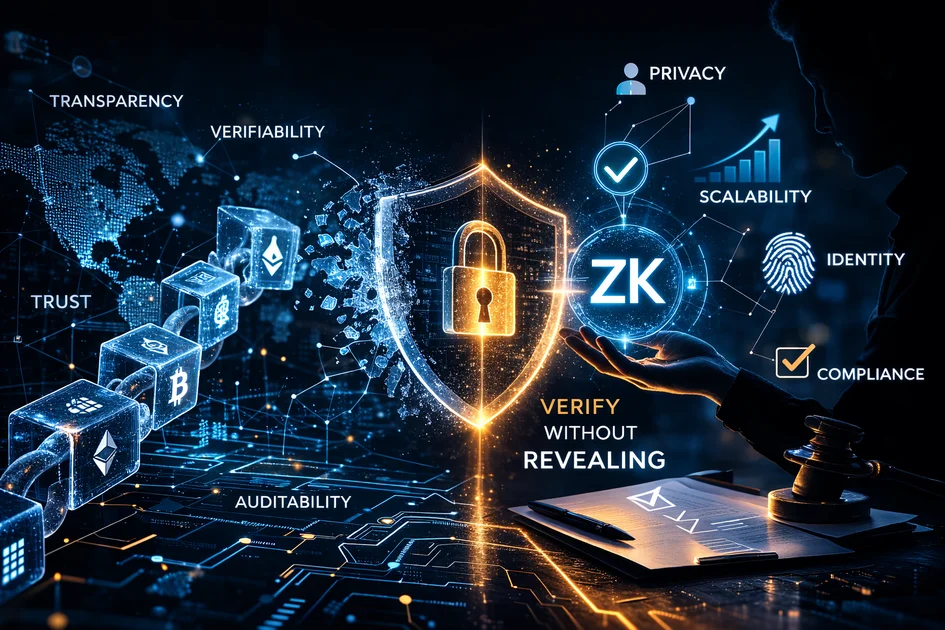
The common thread is simple: verify correctness without exposing underlying data.
Let’s look at where this idea actually shows up in production systems.
Identity and Authentication
Identity verification is one of the cleanest applications for zero-knowledge systems.
Traditional verification models reveal far more information than necessary. Showing a passport proves identity, citizenship, age, and personal details all at once. But most systems only need one fact.
ZK-based identity systems change that interaction.
Instead of sharing the underlying credential, users generate a proof that confirms a specific claim.
A verifier might ask:
• Is this user over 18?
• Is this person accredited to invest?
• Does this credential exist and remain valid?
The proof confirms the answer without exposing the original data.
This pattern is known as selective disclosure.
One implementation comes from Polygon ID, which builds an identity framework around verifiable credentials and zero-knowledge proofs.
The architecture involves three actors:
Issuers create credentials.
Users store them locally in their wallets.
Verifiers request proofs about specific attributes.
When verification happens, the credential never leaves the user’s device. A locally generated proof confirms the claim instead.
Projects integrating this model are using it for:
• token-gated community access
• regulatory compliance checks
• passwordless authentication
• digital credential verification
The important shift is architectural. Identity moves from centralized databases toward self-sovereign credentials verified through cryptography.
Private Financial Transactions
Privacy was the first major application for ZK systems in cryptocurrency.
Public blockchains provide verifiability by exposing every transaction. That transparency enables trustless systems, but it also exposes financial activity.
Early privacy systems attempted to fix this.
The most influential example is Zcash, which launched in 2016 as the first production implementation of zk-SNARK-based private transactions.
Zcash introduced two address types.
Transparent addresses behave like Bitcoin.
Shielded addresses encrypt transaction details.
When shielded transfers occur, the blockchain verifies the transaction through a cryptographic proof rather than visible data. The network confirms that balances remain correct without seeing the sender, receiver, or amount.
Originally this system required a trusted setup ceremony, where cryptographic parameters were generated collaboratively to prevent any single party from controlling the system.
Later upgrades introduced Halo-based proofs, removing the trusted setup requirement entirely while maintaining performance.
Today, Zcash’s shielded pool holds a significant portion of circulating supply, demonstrating that privacy-preserving transactions can function reliably at scale.
However, privacy tools introduced a different challenge.
When Privacy Meets Regulation
The most controversial ZK application came from Tornado Cash, an Ethereum-based mixing protocol launched in 2019.
Its mechanism was simple.
Users deposited ETH into a pool and received a cryptographic note. Later, they could withdraw funds to a new address using a zero-knowledge proof that verified their deposit without revealing which deposit it was.
From a technical standpoint, the system worked exactly as designed.
But regulators argued that the protocol enabled large-scale money laundering.
In 2022, the U.S. Treasury sanctioned Tornado Cash, marking the first time open-source smart contracts were targeted by financial sanctions.
The decision triggered a broader legal debate about whether autonomous code could be treated as sanctionable property.
In 2024, a U.S. appeals court ruled that immutable smart contracts could not be sanctioned because they lack ownership or control.
The episode revealed something fundamental about privacy infrastructure:
cryptographic neutrality creates regulatory tension.
Privacy tools work for everyone. That includes both legitimate users and actors regulators want to stop.
The legal frameworks around decentralized protocols are still adapting to this reality.
Scaling and Compression
Zero-knowledge proofs are no longer just about privacy.
Increasingly, they’re used to reduce the computational cost of blockchain verification.
The logic is straightforward.
Instead of every node re-executing every transaction, one party performs the computation and generates a proof that the result is correct.
Everyone else verifies the proof, which is dramatically cheaper.
This is the foundation of zk-rollups.
Projects like zkSync and Starknet use ZK systems to batch thousands of transactions together and settle them on Ethereum with a single proof.
The result is higher throughput and significantly lower transaction fees while inheriting Ethereum’s security.
The two networks take different approaches.
zkSync focuses on compatibility with the Ethereum Virtual Machine, allowing developers to migrate Solidity applications with minimal changes.
Starknet uses its own language, Cairo, and relies on STARK-based proofs that avoid trusted setup requirements and provide post-quantum security.
Both architectures demonstrate the same principle.
ZKPs allow blockchains to verify computation rather than repeat it, dramatically improving efficiency.
The Extreme Case: Compressing the Entire Blockchain
One project pushes the concept even further.
Mina Protocol asks a radical question: what if a blockchain never grew in size?
Traditional chains accumulate history indefinitely. Bitcoin’s ledger exceeds hundreds of gigabytes. Ethereum’s archive nodes require terabytes of storage.
Mina replaces that history with a recursive proof.
Each block generates a new proof confirming that the previous proof, and therefore the entire chain history remains valid.
Instead of storing historical transactions, the network stores a continuously updated proof of correctness.
The entire blockchain remains roughly 22 kilobytes regardless of transaction volume.
This design enables full node verification on devices as small as smartphones.
Applications on Mina use zkApps, smart contracts that execute off-chain and submit proofs of correctness to the network.
The model reduces data requirements while preserving verification guarantees.
It demonstrates how zero-knowledge proofs can fundamentally reshape blockchain architecture.
The Pattern Behind All These Systems
Despite very different applications, these implementations follow the same structure.
Someone needs to prove something to someone else without revealing everything.
The “something” changes depending on the system.
It might be:
• financial solvency
• transaction validity
• identity attributes
• computational correctness
• entire blockchain history
But the mechanism remains consistent.
A proof replaces exposure.
Roadmap & Hurdles
Zero-knowledge infrastructure continues to face several technical challenges.
Proof generation remains computationally expensive for complex operations. Improving prover performance is an active area of research.
Developer tooling is also still evolving. Writing ZK circuits requires specialized knowledge, which slows adoption compared to traditional smart contract development.
Finally, regulatory frameworks are still adapting to systems where verification does not require visibility.
Despite these hurdles, the direction is increasingly clear.
Zero-knowledge proofs are no longer a niche cryptographic technique. They’re becoming a general-purpose verification layer for decentralized systems.
Privacy, scalability, and succinct verification may look like different problems on the surface.
But ZK systems solve all three with the same idea:
prove the result, not the data behind it.
Replies
Discussion
Join the discussion
Sign in with Google to reply. You stay on this article while you sign in.
No replies yet
Sign in with Google to start the discussion.