Executive Summary
Zero-Knowledge Proof (ZKP) systems have become a foundational component of modern blockchain architecture, particularly for networks prioritizing privacy, scalability, and verification efficiency.
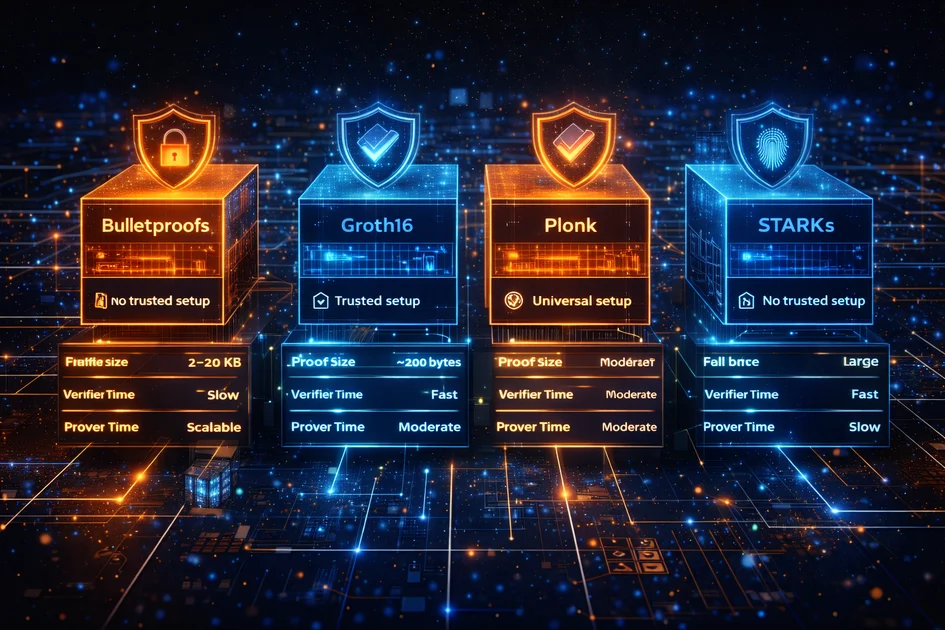
While multiple proof systems exist, such as Bulletproofs, Groth16, Plonk, and STARKs, they differ significantly in proof size, prover time, verification speed, and trust assumptions.
These characteristics determine how suitable each system is for real-world blockchain deployments, especially for privacy-focused Layer-1 networks that must verify proofs quickly while minimizing on-chain data costs.
Among current options, Plonk-derived systems, including implementations like Halo 2 offer a balanced design:
Small proof sizes suitable for on-chain verification
A universal setup rather than circuit-specific ceremonies
Support for recursive proofs, enabling scalable verification
This article analyzes the technical properties, economic implications, and architectural tradeoffs of the most widely used ZKP systems and explains why many modern privacy-oriented networks are adopting Plonk-based architectures.
The Role of Zero-Knowledge in Blockchain Architecture
Blockchains traditionally emphasize transparency, where transaction data is visible and verifiable by any participant. While this property improves auditability, it creates challenges in scenarios requiring confidentiality, such as:
Private financial transactions
Identity verification without exposing personal data
Compliance-sensitive enterprise applications
Scalable off-chain computation
Zero-knowledge cryptography addresses this limitation by enabling a party to prove that a computation is correct without revealing the underlying data.
In blockchain systems, this capability allows networks to:
Verify transactions without revealing sensitive inputs
Compress large computations into succinct proofs
Reduce redundant computation across validators
Enable scalable off-chain execution models
However, the efficiency of these benefits depends heavily on which ZKP system is used.
Evaluating Zero-Knowledge Proof Systems
Most modern proof systems can be compared using four core performance metrics:
1. Proof Size
The size of the generated proof, typically measured in bytes.
Smaller proofs are preferable because they reduce on-chain storage and transaction fees.
2. Prover Time
The time required to generate the proof.
In many blockchain architectures, proving is the most computationally expensive step, particularly when verifying complex programs.
3. Verifier Time
How quickly a network validator can confirm that the proof is valid.
Fast verification is essential for maintaining network throughput and finality.
4. Trusted Setup Requirements
Some systems require an initial cryptographic parameter generation ceremony. If compromised, these parameters could allow malicious actors to produce fraudulent proofs.
Transparent systems avoid this requirement entirely.
Technology Deep Dive: Major ZKP Systems
Bulletproofs
Bulletproofs were designed to eliminate trusted setup requirements while maintaining reasonable efficiency for relatively small cryptographic statements.
Key Characteristics
Trusted Setup: Not required
Proof Size: Typically 2–20 KB or larger
Verification Speed: Moderate
Scalability: Proof size increases with computation complexity
Unlike succinct proof systems, Bulletproofs produce proofs whose size grows linearly with the complexity of the statement being proven.
This makes them suitable for smaller proofs, such as confidential transaction ranges.
Practical Usage
Bulletproofs are widely known for their implementation in Monero, where they are used to hide transaction amounts while maintaining verification capability.
However, for larger programs or general-purpose smart contracts, their increasing proof size becomes inefficient.
Groth16 (zk-SNARK)
Groth16 is one of the most widely used succinct non-interactive zero-knowledge proof systems (zk-SNARKs).
Key Characteristics
Proof Size: ~200 bytes
Verification Time: Extremely fast
Prover Time: Moderate
Trusted Setup: Required for every circuit
Groth16's efficiency in proof size and verification speed makes it extremely attractive for on-chain verification.
However, its main limitation is the circuit-specific trusted setup.
Each new application requires its own setup ceremony, where cryptographic parameters are generated.
If the secret randomness generated during this process often referred to as “toxic waste”, is not properly destroyed, malicious actors could potentially forge proofs.
Historical Context
A notable example of such a ceremony occurred during the launch of Zcash, where participants across multiple continents generated randomness using unconventional entropy sources, including radioactive decay and lava lamps, before physically destroying the hardware used.
While secure in practice, the requirement for repeated ceremonies limits Groth16’s scalability for multi-application ecosystems.
Plonk (Universal zk-SNARK)
Plonk represents an evolution of zk-SNARK design, introducing a universal trusted setup.
Instead of requiring a new ceremony for every application, one setup can support multiple circuits across an ecosystem.
Key Characteristics
Proof Size: Slightly larger than Groth16
Verification Time: Slightly slower than Groth16
Trusted Setup: Universal (one-time)
Flexibility: Supports general-purpose applications
This architecture significantly reduces operational complexity for blockchain ecosystems supporting many decentralized applications.
Halo 2 and Recursive Proofs
Halo 2 is an implementation of the Plonk protocol that introduces an important capability:
Recursive proofs.
Recursive proofs allow a proof to verify another proof, enabling:
Proof aggregation
Scalable verification pipelines
Layered computation structures
This feature is particularly useful for privacy-focused blockchains, where complex transaction logic must remain confidential.
STARKs
STARKs (Scalable Transparent ARguments of Knowledge) were designed to remove trusted setup entirely while providing strong security guarantees.
Key Characteristics
Trusted Setup: None (transparent)
Proof Size: Large (~100–200 KB)
Verification Speed: Fast
Security: Post-quantum resistant
STARKs are highly scalable for provers and excel at validating large batches of computations off-chain.
However, their large proof sizes create challenges for networks where on-chain storage costs and privacy requirements are critical.
Real-World Implementation
A major deployment of this technology can be found in StarkNet, where proofs are generated off-chain and submitted to the blockchain for verification.
This architecture is particularly effective for rollup-based scaling models.
Ecosystem Implications
The choice of ZKP system significantly influences the design of blockchain ecosystems.
Bulletproof-based ecosystems
Typically focus on confidential transactions, rather than general-purpose computation.
Groth16 ecosystems
Often prioritize maximum verification efficiency, but face operational overhead due to repeated trusted setups.
Plonk ecosystems
Provide a balance between flexibility and performance, making them suitable for multi-application privacy networks.
STARK ecosystems
Excel at high-throughput off-chain computation, particularly in rollup architectures.
Economic Considerations
ZKP systems also influence the economic design of a blockchain network.
Key factors include:
Gas Costs
Smaller proofs reduce transaction data costs, improving network efficiency.
Validator Workload
Fast verification ensures validators can process more transactions without compromising block time or finality.
Infrastructure Requirements
Large prover workloads may require specialized hardware, affecting decentralization and participation.
Proof systems with efficient verification but heavier proving costs often shift computation toward specialized prover nodes.
The Blockchain Trilemma Assessment
The blockchain trilemma describes the challenge of balancing:
Security
Decentralization
Scalability
Zero-knowledge proof systems influence each of these dimensions.
Security
Transparent systems like STARKs improve security by eliminating trusted setup assumptions.
SNARK systems rely on trusted parameters but offer well-studied cryptographic guarantees.
Scalability
Succinct proofs dramatically reduce verification costs, allowing networks to handle more transactions per block.
Decentralization
Heavy prover workloads can concentrate computation among specialized operators, potentially reducing decentralization.
The ideal system therefore balances verification efficiency with practical infrastructure requirements.
A Practical Analogy: Choosing a Proof System
Selecting a ZKP architecture can be compared to choosing a shipping method:
System | Analogy |
|---|---|
Bulletproofs | Standard mail: no special setup, but package size grows |
Groth16 | Express courier: tiny package, fast delivery, but custom route setup |
Plonk | Standard logistics network: slightly larger package but reusable infrastructure |
STARKs | Freight shipping: extremely secure for large loads, but containers are large |
Each approach serves a different operational model.
Outlook: Why Plonk-Derived Systems Are Gaining Adoption
As privacy-focused blockchains mature, the requirements for ZKP systems have become clearer.
Ideal systems should offer:
Small proofs suitable for on-chain verification
Reusable setup parameters
Support for recursive proof composition
Efficient integration with complex smart contract ecosystems
Plonk-derived architectures increasingly meet these requirements.
However, adoption challenges remain, including:
Improving prover performance
Simplifying developer tooling
Reducing hardware requirements for proof generation
Despite these hurdles, zero-knowledge cryptography is becoming a core infrastructure layer for privacy-preserving blockchain systems.
As new protocols refine these systems, the focus will likely remain on achieving efficient verification, strong privacy guarantees, and scalable computation without sacrificing decentralization.
Replies
Discussion
Join the discussion
Sign in with Google to reply. You stay on this article while you sign in.
No replies yet
Sign in with Google to start the discussion.